Certified and non-certified
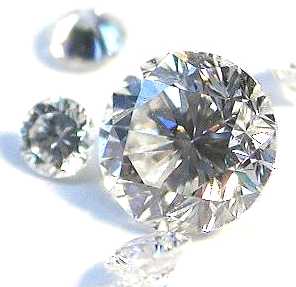
The diamond, from the ancient Greek adamas, meaning invincible, is one of the best-known and most sought-after gemstones. One reason they are so desirable in jewellery is their tendency to disperse white light into its component colours — the fire you see when the stone moves.
Certified diamonds can be judged by four distinct conditions, which in combination determine value. They are commonly known as the four Cs: carat, colour, clarity and cut. We also handle non-certified stones, and we can talk you through the difference before you decide.
Carat
Diamonds are measured in carat weight, abbreviated to ct. One carat weighs 200 milligrams. Carat weight is the easiest of the four Cs to determine, because it is a precise measurement. The weight of smaller diamonds is often expressed as points instead of carats. One carat equals 100 points, so a 25-point stone is a quarter of a carat.
Weight is not the same thing as face-up size. A well-cut stone can look larger than a heavier stone that is cut deep. That is why we look at cut alongside carat before a stone is chosen for a ring.
Colour
Most diamonds are graded on a whiteness scale, or absence-of-colour scale. Tints that may decrease rarity range from yellow to brown to grey. As a rule, the whiter or clearer the colour, the rarer the stone and the stronger the sense of purity. April’s traditional birthstone is the diamond.
| Letters | Group | What you are looking at |
|---|---|---|
| D, E, F | Colourless | No obvious tint to the unaided eye. |
| G, H, I, J | Near colourless | A faint warmth that is hard to see once the stone is set. |
| K, L, M | Slightly tinted | A visible tint. Still a fine diamond, and often a sensible choice for the budget. |
Clarity
Clarity is an important characteristic, and it is worth knowing the grade before you buy. Most diamonds have very tiny natural inclusions and blemishes. The fewer and smaller they are, the higher the quality. Diamonds are graded on a clarity scale, with FL (flawless), or loupe-clean, at the top. That means the highest degree of purity, or freedom from inclusions.
Inclusions form as the diamond crystallises. They are usually natural: carbon spots, other minerals, diamond itself, and crystals such as garnet. Some look like fractures, clouds, feathers, stains, bubbles or tiny crystals.
- FL — Flawless
- IF — Internally flawless
- VVS1, VVS2 — Very, very slight inclusion
- VS1, VS2 — Very slight inclusion
- SI1, SI2 — Slightly included
- I1, I2, I3 — Included
Cut
Cut quality is graded as Ideal, Premium, Very Good (or Fine), Good, Fair and Poor. An ideal cut allows light to enter the diamond, be refracted by its many facets, and bounce back through the top. That characteristic is known as light return.
Shape is a separate choice: round, oval, cushion and the other familiar outlines. Tell us the shape you want and we will look for a stone whose cut actually returns light, rather than one that is only large on paper.
Sourcing and replacement stones
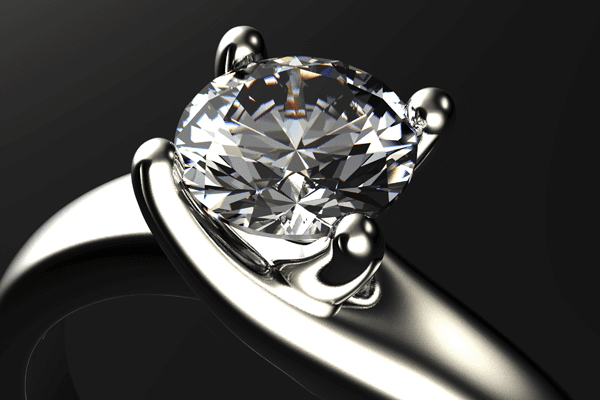
If you require a special certified diamond of a particular shape, quality or size, or a replacement for a lost or broken stone, we can help. Stones are set, re-set and replaced in the same workshop that makes the mount, including delicate claw work.
Bring any paperwork you already have. If a stone needs to match a pair of earrings or a half-missing cluster, say so at the start — matching size and colour by eye is part of the job.
Ask about a stone